Volkswagen tests Gen.Urban autonomous vehicle in Wolfsburg
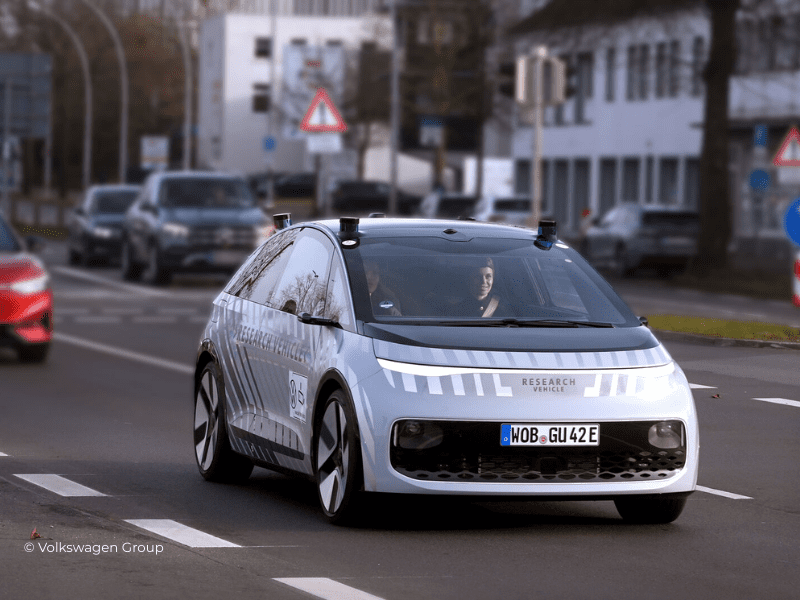
Volkswagen Group has moved its Gen.Urban autonomous research vehicle into real urban traffic, beginning a new test phase on public roads in Wolfsburg. The programme shifts the project from controlled trials to everyday city scenarios, covering intersections, roundabouts and mixed residential and industrial areas.
For eeNews Europe readers, the development offers insight into how large automotive groups are approaching user experience, interior concepts and human–machine interaction for autonomous vehicles. It also highlights how urban test routes are being used to validate not only driving functions, but also passenger acceptance and trust.
Urban testing without traditional controls
The Gen.Urban research vehicle is designed without a steering wheel or pedals, reflecting a future-oriented approach to fully autonomous mobility. During the current test phase, a trained safety driver sits in the passenger seat and can intervene via a dedicated control panel with a joystick if required.
The Wolfsburg test route spans nearly ten kilometres and has been selected to replicate typical urban challenges. It includes traffic lights, roundabouts, construction zones and areas prone to congestion, with each test drive lasting around 20 minutes. Initially, participation is limited to Volkswagen Group employees, with the test phase planned to run for several weeks.
From an engineering perspective, the route provides a repeatable but complex environment for evaluating perception, planning, and interaction strategies in autonomous vehicles, particularly under the variable conditions of city traffic.
Focus on passenger experience and trust
Beyond vehicle control, the research places strong emphasis on how passengers experience autonomous driving. An interdisciplinary team from Volkswagen Group Innovation, including designers, human factors specialists, and software engineers, is collecting data on user behaviour and interaction inside the vehicle.
Key questions include how passengers spend their time during autonomous journeys, which digital features best support work or relaxation, and how interfaces should be adapted for different user groups, such as older passengers or children. The Gen.Urban allows passengers to personalise settings such as temperature, lighting and seating, either via an app or directly inside the vehicle. Artificial intelligence is used to adapt the digital interior, including a wide front display that integrates information, light and sound.
Dr. Nikolai Ardey, Head of Volkswagen Group Innovation, said: “The technology for autonomous driving is making rapid progress. With our Gen.Urban research vehicle, we want to understand exactly how passengers experience autonomous driving. Because: The key to a positive customer experience is to build trust – through meaningful interaction, a relaxed atmosphere, and intelligent assistance systems that respond precisely to the needs of passengers. Ultimately, technology should fit people, not the other way around. We will benefit from these insights across the entire Group in the long term.”
 If you enjoyed this article, you will like the following ones: don't miss them by subscribing to :