Wavefront engineering to tackle 6G test challenges
The next generation of test systems is facing challenges for higher frequencies in the D-Band at 170GHz for 6G as well as challenges for AI, automotive and the Internet of Things.
Nick Flaherty talks to Benoit Derat, senior director development at test system developer Rohde & Schwarz in Munich, on the increasing test challenges in 6G, automotive and Redcap IoT.
Benoit Derat is responsible for system related EMI OTA antenna measurements and customer project implementation in Europe, pulling together groups to develop the components for the instruments.
“Automotive is booming on two sides for us. EVs bring lots of challenges for EMC, the inverters are creating more emissions so we see a growing demand in that space and from a connectivity point of view. The future is autonomous driving where the connectivity will include critical safety features.
“With 6G, what’s pretty clear is that the devices will be more intelligent and more cognisant of the environment so the devices will include sensing and perhaps be able to interact with the environment. This will use the higher frequencies in the D band with wider bands and native AI, that needs research.”
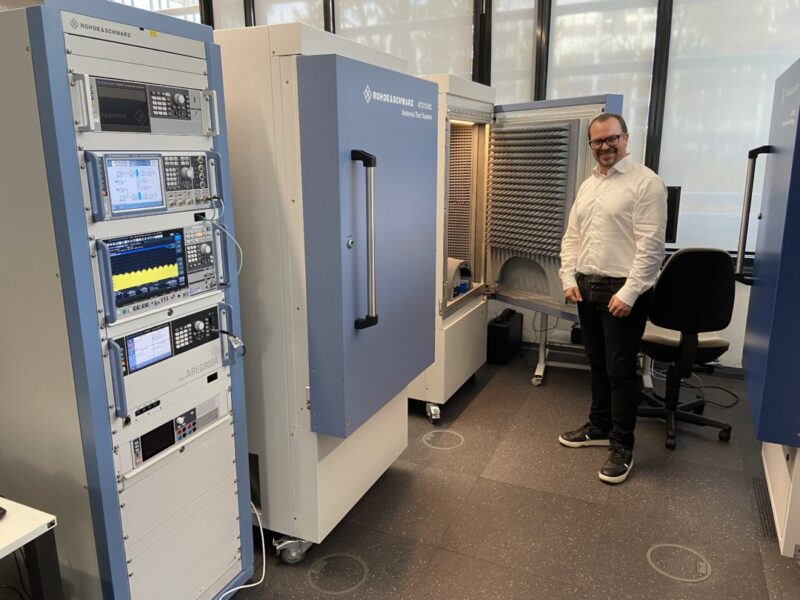
“In the D-band we have a good portfolio for OTA testing and we are expanding that to D band and the developments are quite advanced,” said Derat. This is looking at wideband testing with 8GHz instantaneous bandwidth in the D-band.
- 6G D-band power sensors offer ease use and traceability
- W and D band test systems for 6G and sub-THz research
“Recently we released the SFI with 10GHz bandwidth capability so now we have 8GHz full bandwidth and we are obviously talking about the bandwidth increase. Customers are asking for 16GHz and 20GHz, In these communications and sensing activities there is a need for high instantaneous bandwidth for data but also for pulses like radar for detection. We can see related activities in automotive inside the cabin sensing.”
“I don’t expect the antennas in 6G to evolve more than they are today, they will be more integrated arrays but the concepts will still be around arrays. The evolution will be around how the transceiver and intelligence is integrated. As you go higher in frequency everything around you kills the signal.”
“We are talking about Wavefront engineering. This is near field, while beam forming is more far field.
“If you are able to sense the environment and you can engineer the wavefront, rather than shape the beam you shape the near field so the whole beam goes around an obstruction. All of this needs real time processing and this is definitely a booming topic,” said Derat.
This presents major challenges for the test systems in both static and dynamic environments.
“The multiplicity of conditions you have to test for is exploding so you have to go to higher efficiency test solutions, perhaps blending AI to select the scenarios you need to test.”
“The other aspect is how to integrate the dynamics of the device, with joint communications and sensing as the device moves around. We are exploring these kind of things in a number of European research projects.”
He points to the 6G LICRIS project with Merck and Ericsson with a liquid crystal reconfigurable intelligent surface (RIS) that changes to redirect the high frequency signal. “We are responsible for what the test methodologies.”
“Now we are putting radiation and scattering together, changing the polarity, transferring rather than reflecting the signal, with near field and far field processing so the complexity becomes huge,” he said, “We need to have research projects to look at how to reduce the complexity.”
”We see test requirements increasing greatly in complexity and then we have to get the industry to agree on the testing of RIS and we are very far from that yet,” said Derat.
This is down to the 3GPP and ITA standards bodies.
“The typical way 3GPP likes to work is not to reinvent the wheel so in 5G we laid the ground for reusable test methodologies in 6G with mmWave and massive MIMO basestations we had to figure out how to handle very large devices in a confined space, which led to plane wave synthesis. For me that is very clear, plane wave synthesis will play a significant role in 6G test. The RIS needs something that is impinging and then measure the waves that are transmitted or reflected. This will mostly happen in the 3PGG basestation test side as it replaces the repeater,” he said.
- Rohde & Schwarz teams for 6G digital twin simulation
- KOMSENS-6G project to use 6G networks as sensors
This is a non-signalling over the air (OTA) test so it is spectrum analyser based rather than communications system based, which is driving the product development.
“We need to pick our battles,” said Derat. “For some topics where we think we have enough information so we are in the direction of being 6G ready and there might be a need for rework the systems for 5G. At this point in time we would not do a communications tester for 6G as we don’t know what the 6G waveforms will be but making our spectrum analyser and signal generators are ready for the higher frequencies.”
“One of the things we see is when there is a race, often bandwidth is the first of these races. So its very clear the bandwidth needs will be there so we decided we want to be ahead of the pack for people doing research on the waveforms to have wideband modulation and demodulation.”
He points to the consolidation that happened in test and measurement with 5G with the requirement to measure many different test cases. “Not so many companies can support these requirements,” he said.
There are other parts of Rohde & Schwarz that also help with the development of the test equipment, such as RPG Radiometer Physics GmbH which is developing D-band devices.
“The D-band runs up to 170GHz and our OTA testers were ready for these ranges. RPG is in the group and they are already developing weather radar with 4THz measurement devices and we benefit from this knowledge in the company,” he said.
5G Redcap test
This focus on 6G is not at the expense of other areas such as the latest reduced capacity (Redcap) 5G technology for the Internet of Things (IoT). R&S has developed an integrated test set, the CMX500 OBT lite, for Redcap and the first test system for assisted GNSS navigation.
Although assisted GNSS has been available for many years there are significant test challenges. Being able to test the weakest l5 signals from GNSS satellites without interference from the strong L1 signals requires access to the smartphone firmware for testing with a specialist test mode.
“We expect the peak of the market for Redcap to be about 2027 but already the GCF validations are ongoing and we are #1 in the test case count, over 600 test cases validated. We have been working with the Tier One chipset vendors including Mediatek. We managed to combine so many features together its very cost effective with LTE and wireless LAN in one box.”
 If you enjoyed this article, you will like the following ones: don't miss them by subscribing to :