
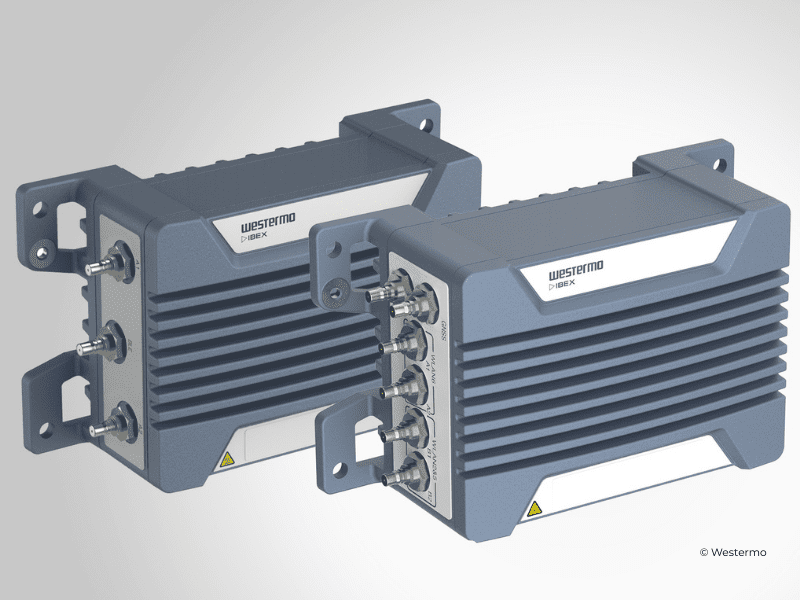
Westermo brings Wi-Fi 7 access points to onboard rail networks
Westermo is extending onboard rail connectivity with Wi-Fi 7 access points (802.11be) designed for high-density passenger and operational networks. The Ibex-1520 and Ibex-3520 are positioned for high-density, interference-prone environments where operators want higher throughput without relaxing safety and certification requirements.
For eeNews Europe readers, the move is a practical signal that Wi-Fi 7 is moving from enterprise roadmaps into rolling stock design-in discussions. It also puts a spotlight on how connectivity upgrades can intersect with certification, EMC, and maintenance workflows on European rail fleets.
What the Ibex-1520 and Ibex-3520 add
Both Wi-Fi 7 access points support Multi-Link Operation and are designed to handle large client counts, which can matter in passenger cars and crew areas where multiple radios compete for airtime. The dual-band Ibex-1520 supports 2.4 GHz and 5 GHz with 2×2 MU-MIMO and up to 512 clients per radio, while the tri-band Ibex-3520 adds 6 GHz operation and supports up to 320 MHz channel bandwidth and 4096-QAM for higher peak data rates in dense scenarios. Bluetooth 5.2 and GNSS are also included, which could be useful for onboard positioning-aware applications and asset tracking.
Ruggedisation, standards, and security focus
Westermo says both devices are certified to EN 50155 and EN 45545-2, and are built for vibration, humidity, and electromagnetic interference typical of rail environments. The company highlights an IP66 metal enclosure, -40°C to +70°C operation, and M12 connectors, plus measures such as a GORE-TEX membrane to reduce internal condensation risk and isolation intended to help with surges and overvoltage events.
On the security side, the access points support WPA2/WPA3, 802.1X with RadSec and persistent security logs, and run Westermo’s IbexOS with regular security updates. In deployment terms, the company points to passenger Wi-Fi, remote maintenance, data offload, and TCMS integration, arguing these Wi-Fi 7 access points could potentially support lower downtime through more reliable onboard connectivity.
 If you enjoyed this article, you will like the following ones: don't miss them by subscribing to :