What is happening at the inside of a nuclear reactor?
Scientists using Polaris and Aurora supercomputers to look at the inner workings of various reactor types
The construction of new nuclear reactors that use advanced technologies and processes could help grow the amount of carbon-free electricity the nuclear power industry produces and help the U.S. progress toward a net zero economy.
Building a new nuclear reactor, however, takes time, and begins with rigorous computer simulations.
Researchers at the U.S. Department of Energy’s (DOE) Argonne National Laboratory are preparing to use Aurora, the laboratory’s upcoming exascale supercomputer, to delve into the inner mechanics of a variety of nuclear reactor models. These simulations promise an unprecedented level of detail, offering insights that could revolutionize reactor design by improving understanding of the intricate heat flows within nuclear fuel rods. This could lead to substantial cost savings while still generating electricity safely.
“What’s really new with Aurora are both the scale of the simulations we’re going to be able to do as well as the number of simulations,” said Argonne nuclear engineer Dillon Shaver. “In working on Polaris — Argonne’s current pre-exascale supercomputer — and Aurora, these very large-scale simulations are becoming commonplace for us, which is quite exciting.”
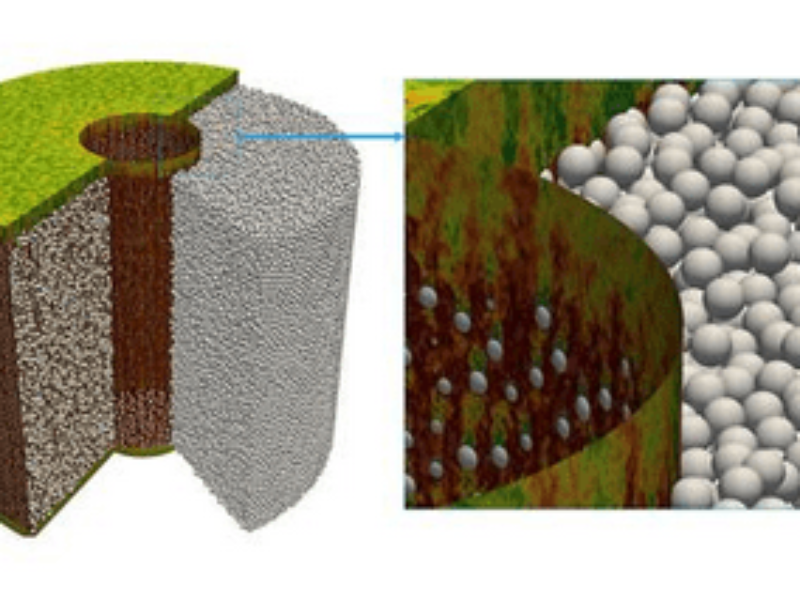
A near-exascale simulation of fluid velocity in a bed of 352,000 randomly packed pebbles in a nuclear reactor. This is one of the most computationally intense nuclear engineering simulations to date. (Image by Argonne National Laboratory.)
The simulations that Shaver and his colleagues are working on look at large sections of the nuclear reactor core with what he terms “high fidelity.” Essentially, there are tens of millions of discrete elements with billions of unknowns in a simulation. Their physics need to be directly calculated and resolved rather than just approximated. That’s where the powerful supercomputers at the Argonne Leadership Computing Facility, a DOE Office of Science user facility, come into play.
 If you enjoyed this article, you will like the following ones: don't miss them by subscribing to :