What the UK’s quantum unicorn deal means for Europe
 Cette publication existe aussi en Français
The billion dollar deal to buy UK quantum pioneer Oxford Ionics well and truly throws the cat among the pigeons (pun intended).
IonQ is a highly acquisitive US startup that has been hoovering up several other quantum technology companies, including ID Quantique in Switzerland, LightSync, and the assets of quantum networking pioneer Qubitekk.
It may not be obvious, but the gun has fired on the consolidation of the quantum industry, and Europe risks missing out despite having key technological advantages.
The deal, worth $1.065 billion in stock and $10m cash will potentially see IonQ leapfrog its competition by moving to trapped ion technology, Oxford Ionics is a world leading supplier of this technology, with deals with Infineon Technologies and quantum computing giant Quantinuum.
The risk to the existing deals has been clear and IonQ is at pains to explicitly state that all the existing deals, such as those with Infineon and Quantinuum, will be honoured. For now.
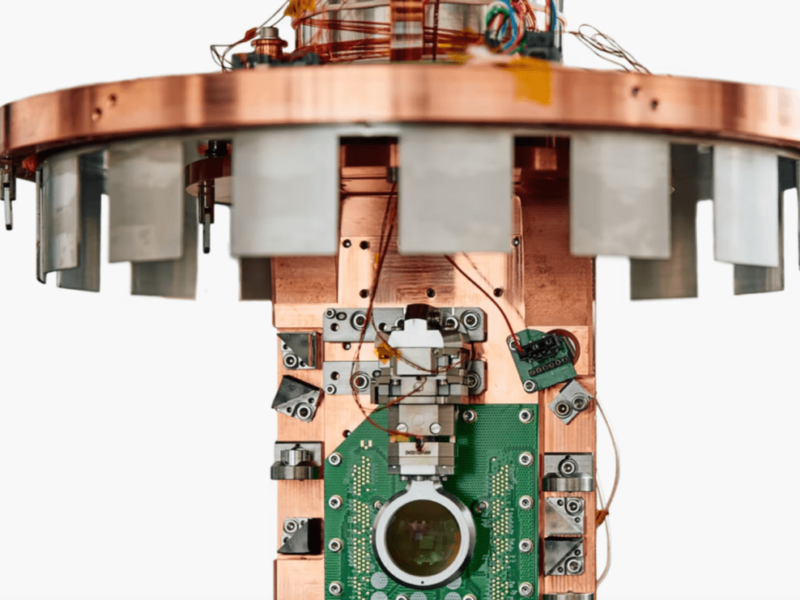
Trapped ions on a semiconductor chip is a key technology for Europe. Infineon has been driving the manufacturing technology, and the CHAMP-ION pilot line has just been commissioned in Austria to further develop the technology. The naming gives away the thinking – this is a ‘champion’ technology for the region that is now in the hands of a US company. The cat qubit is another champion technology.
The combined company expects to build systems with 256 physical qubits at accuracies of 99.99% next year with over 10,000 physical qubits with logical accuracies of 99.99999% by 2027. More importantly it is looking at 2 million physical qubits in its quantum computers by 2030, enabling logical qubit accuracies exceeding 99.9999999999%. This will drive
This is the cat among the pigeons, surpassing the roadmap recently announced by Oxford Quantum Circuits just last week that will see a machine with 50,000 logical qubits in 2034. IBM has also pitched in, offering a system called Starling with 100m quantum gates to provide 200 logical qubits by 2029. This will be followed by Blue Jay with 1bn gates providing 2,000 logical qubits in 2033.
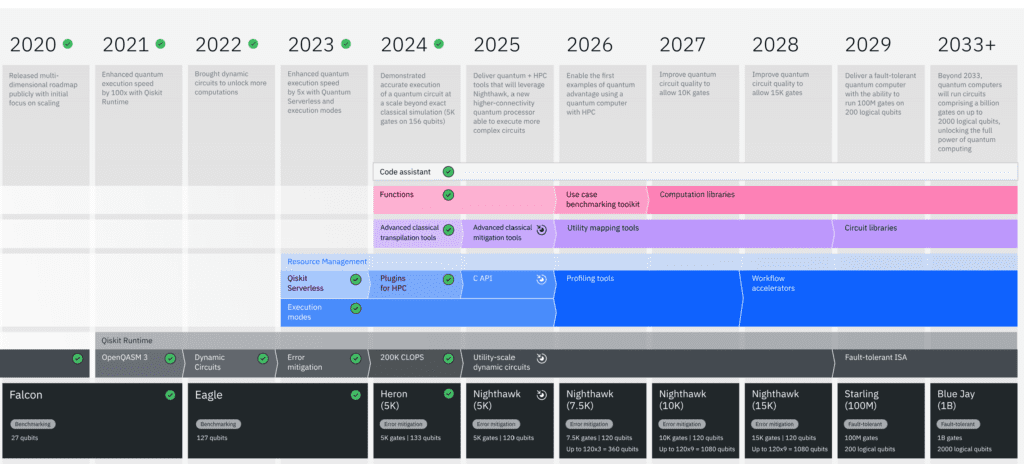
IBM’s quantum roadmap
In this situation, the backing of the company is key. IonQ has raised a total of $84m from Lockheed Martin, Robert Bosch Venture Capital GmbH (RBVC), and Cambium, a new multi-stage venture capital firm, but the last funding was an extended Series B round back in 2020.
Other investors include Samsung Electronics, Mubadala Capital, GV, Amazon, and NEA. Institutional holders of IonQ stock include Vanguard Group, Blackrock, Shaw D.E. & Co and Morgan Stanley. This reported to have given the company access to over $324m of debt funding.
Market predictions for quantum computing are a finger in the air, especially for more than a decade away, but IonQ is citing numbers from Boston Consulting that put the market at $850bn by 2040.
The example is the merger of Honeywell’s quantum hardware with the software skills of Cambridge Quantum to form Quantinuum back in 2021. That was another unicorn deal, with a $300m investment in 2024 valuing the company at $5bn.
IonQ is sweetening the deal. Both Oxford Ionics founders, Dr. Chris Ballance and Dr. Tom Harty, are expected to remain with IonQ after the acquisition is completed, continuing their pioneering work on quantum technology development in the UK. The combined entity also plans to expand its workforce in Oxford to further develop the UK’s position as a leader in quantum computing.
“IonQ’s vision has always been to drive real-world impact in every era and year of quantum computing’s growth. Today’s announcement of our intention to acquire Oxford Ionics accelerates our mission to full fault-tolerant quantum computers with 2 million physical qubits and 80,000 logical qubits by 2030,” said Niccolo de Masi, CEO of IonQ. “We believe the advantages of our combined technologies will set a new standard within quantum computing and deliver superior value for our customers through market-leading enterprise applications.
“The groundbreaking ion-trap-on-a-chip technology will accelerate IonQ’s commercial quantum computer miniaturization and global delivery. Our combined path to millions of qubits by 2030 will help ensure unit economics, scale, and power as quantum computing rapidly evolves,” he said.
“Together, we intend to move faster than any other player in the industry to deliver the leading fault-tolerant quantum computers with transformative value for customers,” said Balance. “At Oxford Ionics, we have not only pioneered the most accurate quantum platform on the market – we have also engineered a quantum chip capable of being manufactured in standard semiconductor fabs. We look forward to integrating this innovative technology to help accelerate IonQ’s quantum computing roadmap for customers in Europe and worldwide.”
One factor that will have kept Balance and Harty engaged is the advisory team at IonQ, This includes Umesh Vazirani, Roger A. Strauch Professor of Electrical Engineering and Computer Sciences and the co-director of the Berkeley Quantum Computation Center (BQIC), as well as David Wineland, Nobel Laureate and Philip H. Knight Distinguished Research Chair, University of Oregon, Department of Physics and Margaret (Peg) Williams, former Senior Vice President of Research and Development, at HP Cray.
Europe still has some cards to play, with innovative ion trap technology spinning out of ETH Zurich. But what is lacking is the backing and the deal making to ensure that the region remain relevant in quantum computing technology in years to come.
www.ionq.com; www.oxionics.com/tech
 If you enjoyed this article, you will like the following ones: don't miss them by subscribing to :