Wi-Fi 7 XGS-PON reference platform cuts power usage
MaxLinear has announced that it has achieved substantial improvements for idle and active power modes using its Wi-Fi 7 XGS-PON reference platform, setting the stage for more environmentally sustainable home networking using sub-5-W home routers and gateways.
Empowering network operators to be able to meet a 55% CO2 reduction goals by 2030, MaxLinear has optimized power consumption for numerous Wi-Fi 7 use cases for high-performance home gateway units (HGU).
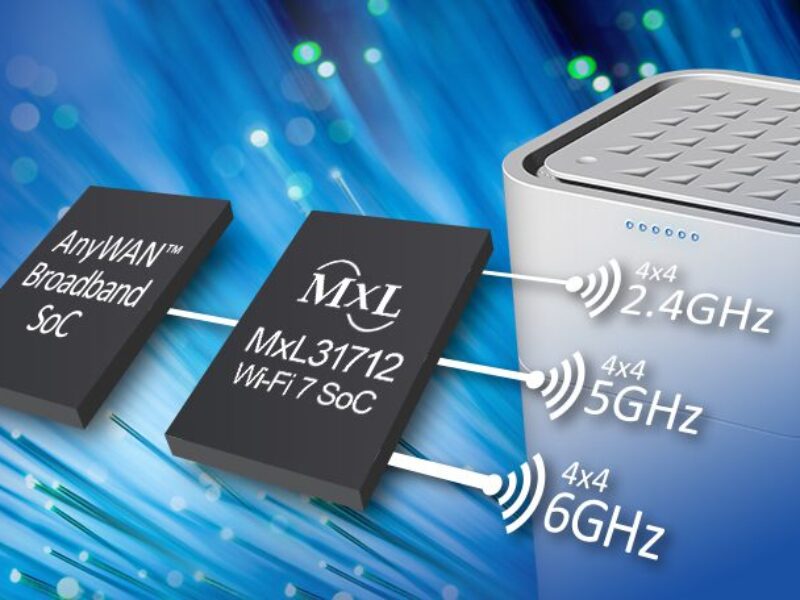
The Wi-Fi 7 platform consumes no more than 5.7 W of power while idling and less than 7.4 to 9 W in typical usage scenarios, such as video streaming over an XGS-PON fiber link to a Wi-Fi client. At these levels, power consumption is reduced by half of comparable products on the market. The reference platform features the AnyWAN URX851 — MaxLinear’s universal, ultra-scalable broadband SoC — and the MXL31712 Wi-Fi 7 radio, which integrates the tri-band 4+4+4 MAC plus RF in a single chip.
“Power efficiency need not translate to lower SoC performance,” said Will Torgerson, VP/GM Broadband Group at MaxLinear. “Being able to offer high-performance technology with advanced power management is one of the most critical design factors for the new generation of home gateways. With the power management on the MaxLinear Wi-Fi 7 reference platforms, we are paving the way for commercial sub-5-W tri-band Wi-Fi 7 home gateways —taking energy efficiency to a new level to help our customers become carbon neutral.”
The growth in power hungry, always-on HGUs has prompted many operators to find ways to increase energy efficiency of their products. Many service providers are targeting a 55% CO2 reduction by 2030 and 100% carbon neutrality by or before 2050. To achieve these greenhouse gas (GHG) emission targets, many companies are optimizing their operations, sourcing greener products, and reducing energy use of “always on” equipment in consumer homes.
“With global fixed broadband subscribers projected to grow from 1.21 billion in 2023 to 1.34 billion by 2028, even small improvements in the energy efficiency of Wi-Fi CPE could deliver significant reductions in global greenhouse gas emissions,” said Andrew Spivey, Senior Analyst, ABI Research. “The number of Wi-Fi CPE shipped annually is also expected to rise, with a forecasted increase from 273.1 million in 2023 to 397.4 million by 2028. Wi-Fi 7 CPE is also expected to see an exponential jump from 11 million in 2024 to 258.9 million in 2028. Clearly, with the number of Wi-Fi CPE shipped to consumers expected to grow, reducing their energy consumption is becoming more important than ever. And with sustainability now at the top of everyone’s mind, this could prove to be a key differentiator for Wi-Fi CPE of the future.”
The MaxLinear Wi-Fi 7 platforms feature numerous power domains for dynamic voltage and clock scaling adapting to the current performance needs. System-wide power scaling, such as advanced Wi-Fi performance scaling and band steering, is software configurable easily through standard (Linux) APIs.
Thee MaxLinear Wi-Fi 7 SoCs offer a world-first single chip option that helps to reduce board complexity, size, and BOM cost. Further, the single chip affords a seamless, coordinated view of multiple bands for an optimal Multi-Link Operations experience. With multi-gigabit speeds, low latency, and support for a massive number of connected devices, the MaxLinear Wi-Fi 7 SoCs are poised to revolutionize wireless communication, enabling next-generation applications such as augmented reality and ultra-high-definition streaming.
The MaxLinear AnyWAN™ SoCs ‚— the MxL25641, URX850, and URX851 — deliver high levels of integration to enable power- and cost-efficient high-performance home connectivity products. The universal broadband SoCs support all high-speed data access and in-home connectivity technologies, including Fiber-to-the-Home, Fixed Wireless Access, DOCSIS and Ethernet Broadband Access. While the main use case is telco service provider and cable MSO gateways with dual-band and tri-band Wi-Fi 6E or Wi-Fi 7 configurations, the SoCs can be used in applications such as SMB gateways, NAS storage devices, distribution point units, and cellular small cells.
The SoCs ensure faster time to market and reduces R&D costs, enable wirespeed Wi-Fi 7 throughput, scale power consumption to performance needs via adaptive power management, and allow differentiated services due to quad-core CPUs.
 If you enjoyed this article, you will like the following ones: don't miss them by subscribing to :