Wireless SoCs boost efficiency and computation in IoT applications
Silicon Labs has unveiled the first products of its Series 3 portfolio, introducing two new wireless SoC families built on the advanced 22-nm process node: the SiXG301 and SiXG302. These wireless SoCs represent a significant advancement in computing power, integration, security, and energy efficiency, meeting the increasing demands of both line-powered and battery-operated IoT devices.
The Series 3 portfolio of multi-radio wireless SoCs features a common code base that spans over 30 devices for backwards compatibility with Series 2. This ensures scalability, more efficient development and application portability. Flexible manufacturing mitigates supply risks and includes memory options that future-proof designs. Series 3 also boasts more than 100x the processing capability, including an integrated AI/ ML accelerator for edge devices, enabling consolidation of system processing into these wireless SoCs.
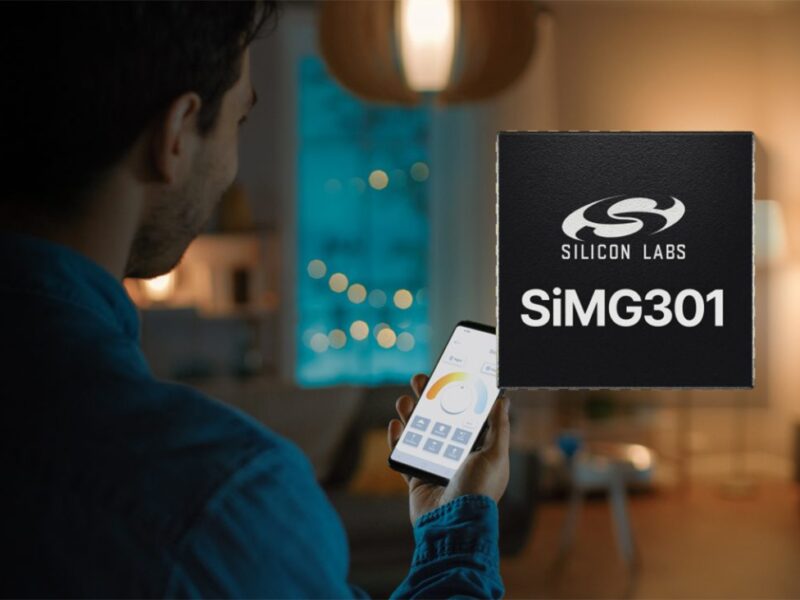
Purpose-built for line-powered smart devices, the SiXG301 includes an integrated LED pre-driver. It is ideal for advanced LED lighting and smart home products and enables multi-protocol operation using Bluetooth, Zigbee, and Thread, with support for Matter. Built with a high Flash and RAM overhead of 4 MB and 512 kB, respectively, the SiXG301 helps future-proof customer designs as the requirements for Matter and other more demanding IoT applications continue to grow. Concurrent multi-protocol operation for Zigbee, Bluetooth, and Matter over Thread networks simultaneously helps simplify manufacturing SKUs, reduce costs, and save board space for additional device integrations. SiXG301 wireless SoCs are slated for general availability in Q3 2025.
Expanding Series 3 to battery-powered applications, the upcoming SiXG302 wireless SoCs will deliver groundbreaking energy efficiency without sacrificing performance. Featuring an advanced power architecture, the SiXG302 is designed to use only 15 µA/MHz active current, 30% lower than competitive devices in its class. This makes it ideal for battery-powered wireless sensors and actuators for both Matter and Bluetooth applications. The SiXG302 is planned for customer sampling in 2026.
“Smart devices are becoming more complex, and designers are challenged to pack greater functionality into smaller spaces while maintaining energy efficiency,” said Ross Sabolcik, Senior Vice President of Product Lines at Silicon Labs. “With the SiXG301 and upcoming SiXG302 families, we’re delivering flexible, highly integrated solutions that enable next-generation IoT devices—whether they’re plugged in or running on battery power.”
The SiXG301 and SiXG302 wireless SoCs will initially include “M” devices for multiprotocol, the SiMG301 and SiMG302, and “B” devices optimised for Bluetooth LE communications, the SiBG301 and SiBG302.
 If you enjoyed this article, you will like the following ones: don't miss them by subscribing to :