Broadband LED hits record output
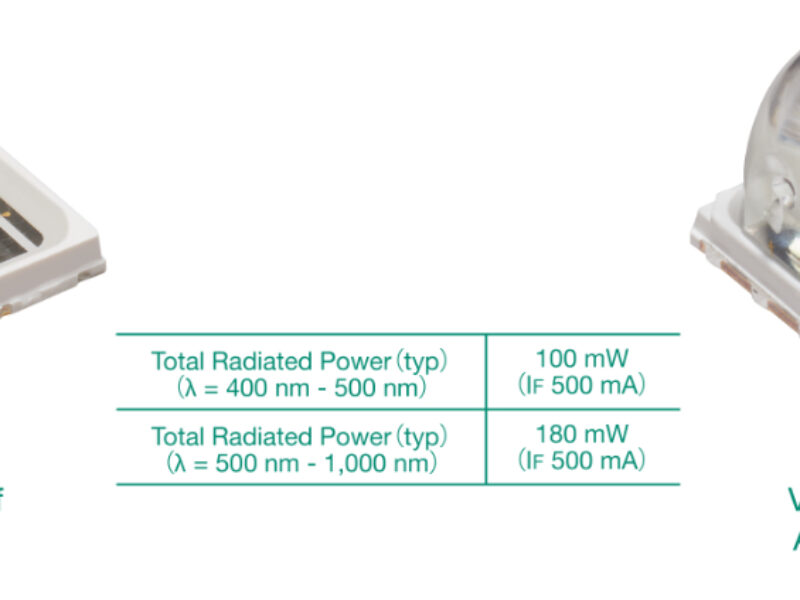
The Spectro indium gallium nitride (InGaN) broadband LED chip achieves a new record output power of 180 mW across the total broadband visible and near infrared (NIR) spectrum from 400nm to 1,000nm
The 1mm2 chip in a SMBB package also features high levels of heat dissipation and a choice of lens options for pairing with photodetector sensors and spectral imaging cameras. Capturing the spectral absorption properties of common materials allows automated systems perform categorization, quality assurance, and other sorting tasks. Potential applications include detecting moisture content within an object, such as in optical food sorting applications, or monitoring the fill level of a medicine bottle.
Multiple broadband LED chips can be implemented depending on the required output power, with customised versions also possible.
The absorption characteristics of near infrared (NIR) light differ from one substance to another, so these LEDs lend themselves well to applications such as determining the type and quantity of a substance. Simultaneously identifying multiple materials, each with a different peak light absorbency, is possible by deploying separate LED and sensor packages to illuminate and detect each respective material independently.
Using CMOS sensors to detect how much of the broadband LED emissions are absorbed, it is possible to identify multiple materials within a substance while only using one broadband light source. This allows a system to recognize multiple materials within an object and can also provide accurate quantitative measurements.
Applications for the broadband LED devices include checking the sugar content of a soft drink or monitoring blood oxygen saturation. Since the broadband output includes wavelengths in the visible spectrum, more applications are able to utilize broadband LEDs and the spectral emission of Spectro is roughly in-line with the spectral sensitivity of the CMOS photodetector typically employed in common sensory devices. This offers incredible possibilities for implementation such as the sorting of items by material, colour, or the detection and removal of foreign matter from a production process.
Related broadband LED articles
- Infrared LED targets consumer spectroscopy
- Infrared LED helps farmers plan harvest time
- Nano-structured white LED delivers broadband emission
- The entire light spectrum of the sun in one LED
Other articles on eeNews Europe
- New CTO for Siemens Digital Industries
- IBM shows first 2nm chip
- Swiss interconnect maker buys UK photonic startup
- Chip shortages worsen for car makers
- GlobalFoundries to make quantum photonic chips in Dresden, New York
- UK appoints innovation chief after three year search
 If you enjoyed this article, you will like the following ones: don't miss them by subscribing to :