Compostable sensors for digital agriculture
Compostable, screen-printed soil sensors are being used to monitor crops in the UK as part of a pan-European ‘digital agriculture’ project.
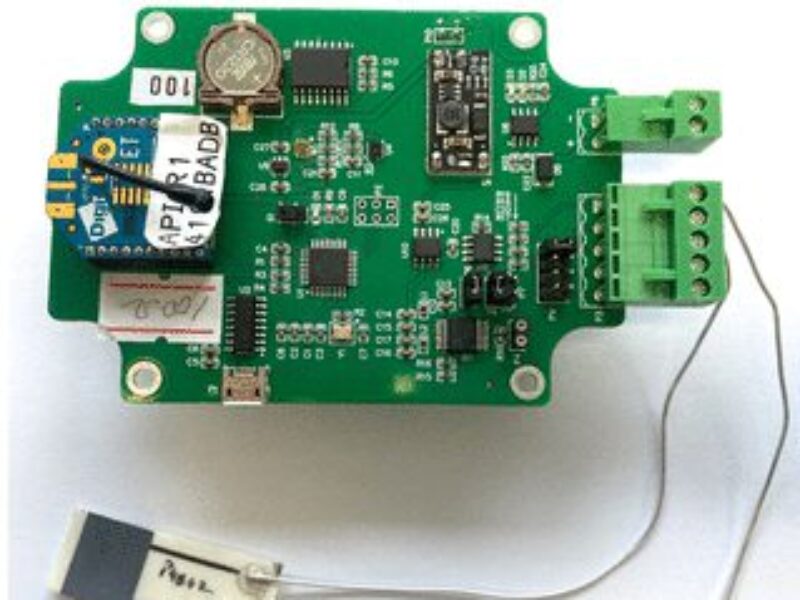
The system combines a screen-printed biodegradable impedance sensor with a reuseable electronic module powered by a solar cell.
The sensors were developed by engineers from the University of Glasgow with the Łukasiewicz Institute of Microelectronics and Photonic (IMiF) in Poland. Conductive tracks are printed onto a biodegradable polymer substrate using graphene-carbon ink, then a sensing layer made from molybdenum disulfide is printed on top. These naturally break down into plant nutrients.
The team say their modular approach enhances the reusability of the overall existing electronic systems and significantly reduces electronic waste, resulting in a much lower overall environmental impact. Detailed environmental impact assessments conducted by the researchers shows that operating the electronics in this way improves sustainability.
The sensors are sensitive to the changes in pH and temperature which can be caused by infections in crops and the data is collected by the electronic module with a Zigbee wireless link back to a gateway.
The research is a key development in a wider international project called TESLA, which stands for Transient Electronics for Sustainable ICT in DigitaL Agriculture. The £1.8m project is funded by UK Research and Innovation and CHIST-ERA, a consortium of research funding organisations in Europe and beyond.
TESLA is led by the University of Glasgow with McGill University in Canada; Tampere University and VTT Technical Research Centre in Finland; Łukasiewicz; and CSEM in Switzerland.
The project aims to develop a complete system where the biodegradable sensors are powered by solar cells and supercapacitors also made from sustainable materials, enabling a fully environmentally-friendly solution for precision agriculture monitoring.
The module is based around the including the ATmega644PA microcontroller (MCU) and several integrated sensors: the SHT31 for temperature and humidity, the TSL2591 for light levels, the AD5933 for impedance measurements and the DS3231 real-time clock (RTC). The RTC ensures accurate timing for synchronized data collection through its temperature-compensated crystal oscillator.
The sensor node was constructed with an AD5933 12bit ADC as an impedance converter, which is capable of impedance analysis. Deploying multiple sensor nodes equipped with the AD5933 enables the monitoring of a system simultaneously at multiple points. This capability is vital in applications requiring comprehensive coverage or transmitting data for offsite analysis.
An important aspect of the design was to minimize the power consumption, so that the node could be powered by an organic photovoltaic cell under indoor lighting levels, maintaining the battery charge level and ensuring long-term and autonomous operation.
Although the node can consume approximately 370 mW when it is actively transmitting data, it requires about 1 mW when it is in sleep mode and 15 mW when sampling data from the impedance node.
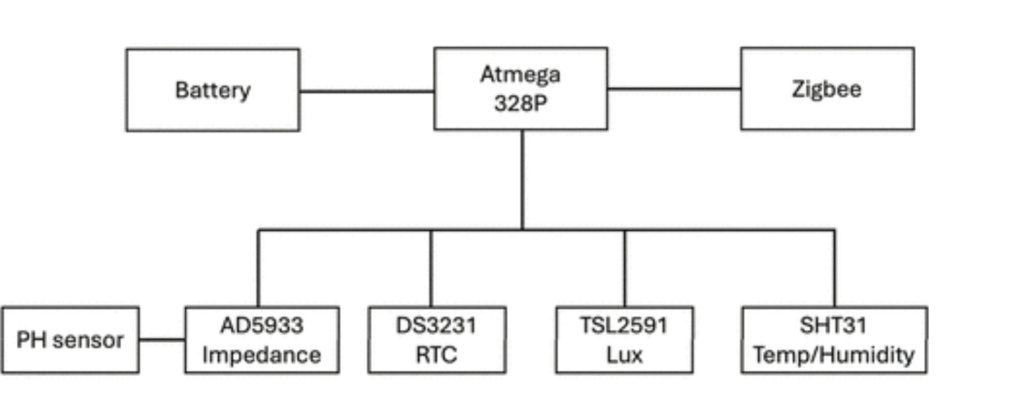
The energy consumption largely depends on transmission rate and consumes 14.3 mW h of energy per day with 6 transmissions. This was achieved by using sensors capable of low power sleep modes, an IC load switch to turn off the impedance sensor, and putting both the Digi ZigBee module and MCU into sleep mode between measurements. The only component that stayed awake was the RTC, which toggled a hardware interrupt on the MCU after a set period had elapsed, allowing the next measurement cycle to be initiated.
Lab tests showed the sensors can reliably monitor soil pH levels, with consistent performance demonstrated in solutions ranging from pH 3 to pH 8 over the course of two weeks. The team also demonstrated that that the sensors can detect traces of ethephon, a widely used plant growth regulator that can be toxic to humans and wildlife if it contaminates groundwater. At the end of their useful lifecycle, the sensors degrade into key primary and secondary nutrients to support future plant growth.
“The system we’ve developed could go a long way towards cutting down the carbon footprint of digital agriculture. The sensors themselves can be ploughed back into the fields to help nurture crops, and the electronic modules with less environmentally friendly printed circuit materials can be reused for several years,” said Andrew Rollo of the James Watt School of Engineering
“Our analysis suggested that replacing the sensors once every three months could reduce the environmental impact of the system by 66%, and 79% over five years compared to disposing of the entire device each time.”
The next step is to expand the sensor range.
“We’re keen to continue expanding our biodegradable sensor’s ability to detect other key indicators of plant growth and soil health. That could include adding sensitivity to ‘forever chemicals’ like PFAs, which have significant environmental impact,” said Professor Jeff Kettle who led the research.
 If you enjoyed this article, you will like the following ones: don't miss them by subscribing to :