Honda taps digital twin supercomputer for air taxi R&D
Cadence Design Systems has launched a digital twin system for multiphysic analysis of CFD and LES in automotive, aerospace and power designs.
The Cadence Millennium Enterprise Multiphysics Platform is the industry’s first hardware/software (HW/SW) accelerated digital twin for multiphysics system design and analysis and is being used by Honda for a eVTOL air taxi design..
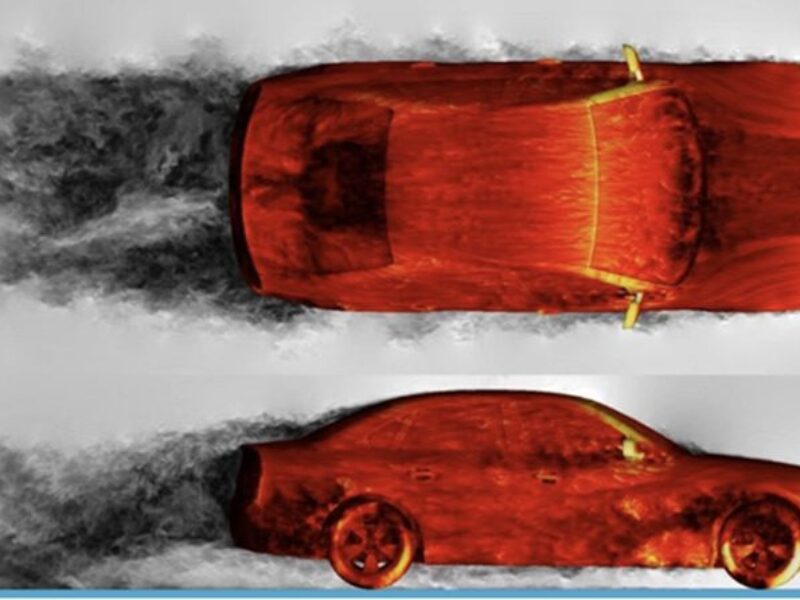
The hardware is the Cadence Millennium M1 CFD Supercomputer, the industry’s first turnkey CFD computing system with a combination of graphic processing unit (GPU) to run computational fluid dynamics (CFD) and large eddy simulations (LES) on scalable high-performance computing (HPC) hardware. This is used for the generation of high-quality synthetic data that enables generative AI to quickly identify optimal system design solutions without compromising accuracy.
Honda and Cadence have worked together for more than 10 years to accelerate CFD design processes. “Our deployment of Cadence’s Millennium M1 multiphysics supercomputing platform, with its LES solver, has demonstrated significantly faster turnaround time and the scalability to simulate much larger systems for aerodynamics, combustion and aeroacoustics applications for our automotive, aeropropulsion and eVTOL projects. With the potential for significant acceleration of high-fidelity CFD simulations, we look forward to continuing our collaboration to develop next-generation CFD solutions,” said Atsushi Ogawa, Chief Operating Officer at Honda R&D.
The digital twin supercomputer is available in the cloud or on premises and Millennium M1 instances can be fused into a unified cluster, enabling customers to achieve an unprecedented same-day turnaround time and near-linear scalability when simulating complex mechanical systems. The launch also comes as arch-competitor Synopsys plans to buy Ansys in a $35bn deal largely driven by CFD simulation technology.
Designing mechanical systems for new levels of performance and efficiency has become a key priority in the automotive, aerospace and defence (A&D), energy and turbomachinery industries. Digital twin implementations based on multiphysics simulation technology need performance and accuracy, and this needs scalable, high performance computing resources.
- Synopsys to buy Ansys in $35bn simulation move
- Cadence develops AI thermal design and analysis platform
The Millennium Platform supports CFD solvers running on dedicated GPU hardware alongside up to 1000 CPU cores. This reduces the turnaround time from weeks to hours with 20X better energy efficiency compared to its CPU equivalent. The system is available with GPUs from Nvidia or AMD, in the cloud with minimum 8 GPU configurations, or on premises with a minimum 32 GPU configuration.
“Algorithmic throughput remains a key priority, and we’re now leveraging generative AI to harvest knowledge gained from massive quantities of design and simulation data,” said Ben Gu, corporate vice president of R&D for multiphysics systems analysis at Cadence.
“Cadence’s Millennium M1 with its CharLES solver’s high-fidelity flow simulation technology represents the state-of-the-art in computational fluid dynamics, leveraging recent innovations in numerical methods, physical modeling, and GPU computing,” said Professor Parviz Moin, Stanford University and Founding Director of the Center for Turbulence Research (CTR).
“This mixture of accuracy, speed and scale is already impacting the design of aerospace, automotive, and energy systems where turbulence plays a critical role and will usher in a new generation of predictive simulations. In addition, the significantly increased rate of production of high-quality simulation data will greatly enhance our ability to develop control and modeling concepts including AI-based models and the realization of digital twins.”
“Our collaboration with Cadence has been exceptional. ASUS is excited to work with Cadence on their new Millennium platform, which delivers exceptional performance and energy efficiency through Cadence’s revolutionary combination of hardware and software. We look forward to our continued partnership to address AI-enabled digital twin designs and multiphysics simulation challenges today and in the future,” said Paul Ju, Corporate Vice President and CTO of Data Center, ASUS.
www.cadence.com/go/millenniumpr
 If you enjoyed this article, you will like the following ones: don't miss them by subscribing to :