imec, Ceva team on CMOS UWB transceiver that slashes power
 Cette publication existe aussi en Français
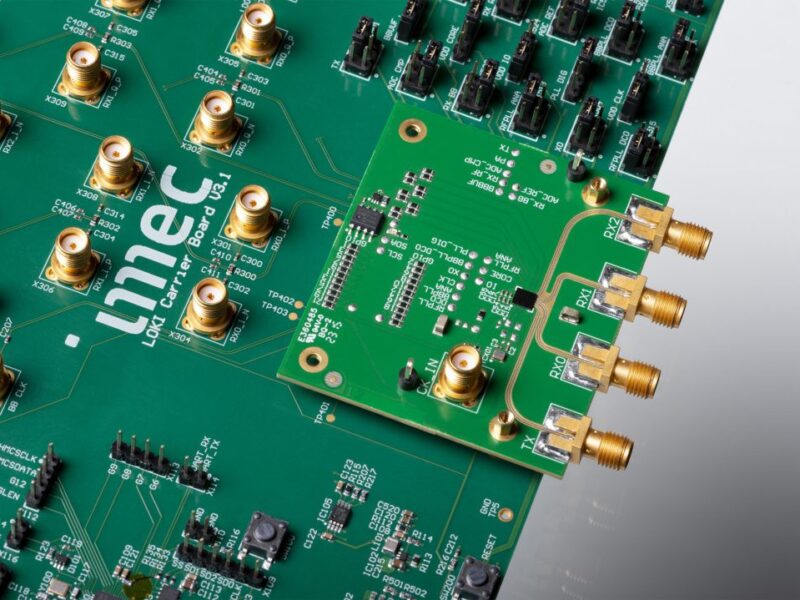
imec in Belgium has developed an ultrawideband transceiver in 28nm CMOS with a record lower power consumption that will be used by Ceva for sensor IP.
The 1.33mm² IEEE 802.15.4z IR-UWB transceiver developed by imec operates in the 6 to 9GHz band and achieves 1.4mm ranging precision with just 8.7mW/21mW in continuous Tx/Rx mode with three receivers.
One use for the transceiver is UWB radar-on-chip systems for in-cabin (child) presence detection or driver monitoring, but IR-UWB technology is an enabler of multiple smart industry, smart home and IoT use cases.
One of IR-UWB’s main differentiators is that it largely outperforms narrowband technologies such as Bluetooth with the ranging precision. However it uses more complex and expensive circuits and typically exhibits higher power dissipation. This makes the combination of the ranging precision with the lowest power consumption significant while meeting UWB’s tight international spectral emission regulations with sufficient margin.
- Low power UWB chip for wireless AR smart glasses
- imec adds machine learning to UWB for improved security
“With the presentation of our UWB transceiver chip, imec overcomes yet another hurdle to UWB’s widespread adoption. Building on a cost-efficient silicon layout, the transceiver achieves the best-ranging precision with the lowest power consumption among state-of-the-art IEEE 802.15.4z radios,” said Christian Bachmann, program director of wireless sensing at imec.
A distributed two-stage all-digital PLL allows for further reduction of the chip’s power consumption and contributes to a reduced measurement time for localization. To improve its ranging performance (while complying with spectrum regulations), the system makes use of an analog finite impulse response (FIR)-based Tx pre-emphasis approach for more advanced, flexible pulse shaping.
- Packetcraft joins FiRa Consortium, announces UWB technology
- UWB sensing solutions for emerging IoT use cases
“Going forward, industry requires high-performance, low-power UWB transceivers that can support a multitude of use cases. We believe this chip could ultimately support a whole new generation of UWB use cases, combining UWB ranging, communications and radar functionality. It is a technology that could find its way into automotive applications such as in-cabin presence detection, and driver monitoring – both of which stand or fall with the measurement accuracy and energy efficiency of the underlying technology,” said Bachmann.
imec conducts its research in collaboration with a wide range of industrial partners, including IP licensor Ceva. “Ceva fully endorses imec’s belief in the massive potential of UWB in a wide variety of applications, including demanding automotive applications such as in-cabin radar for child presence detection. Teaming up with imec in the UWB realm enables us to offer a complete solution to accelerate the time to market for our joint customers, leading the way in the era of connected devices and smart industries,” said Tal Shalev, Vice President and General Manager, of the Wireless IoT BU at, CEVA. “Ceva’s UWB 802.15.4z modem plus CCC/FiRa MAC has low power, low latency and a high-precision ranging architecture that perfectly complements imec’s novel UWB transceiver”.
www.imec-int.com; www.ceva.com
 If you enjoyed this article, you will like the following ones: don't miss them by subscribing to :