Large woven display for the smart home and IoT
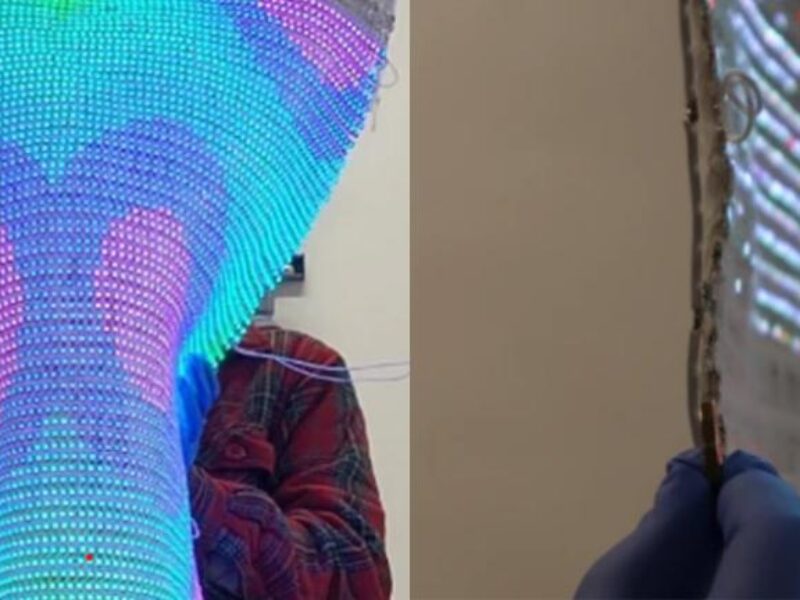
An international team of researchers has developed a 46-inch (116cm) woven display with smart sensors, energy harvesting and storage integrated directly into the fabric for the first time.
The display, developed with researchers from LG and Samsung, is built from red, green and blue LEDs coupled with multifunctional fibre devices that are capable of wireless power energy harvesting with a 13.56MHz RF antenna, touch sensing, photoadetection, environmental/biosignal monitoring, and energy storage. These are woven into a fabric using conventional weaving, conductive adhesives and laser welding techniques.
Led by the University of Cambridge, the team includes 48 researchers across Europe and Korea, with NOVA University Lisbon and the Centre for Nanotechnology and Smart Materials (CeNTI) in Portugal, Bioelectronics and Advanced Genomic Engineering (BIOAGE), Solvay Specialty Polymers and SAATI in Italy, Textile Research Institute Thuringia-Vogtland (TITV) in Germany, Unitat de Teixits Funcionals in Spain as well as display makers LG and Samsung and construction by Silvaco Europe in St Ives, UK.
The researchers mounted the LEDs with a 7 mm and 5 mm pitch on a 4mm wide flexible copper fibre with electrodes patterned by chemical copper etching. Solder paste was applied to each LED mounting location. After placing LEDs aligned with soldering paste on a copper fibre, hot-dry reflowing (< 250 °C, solidifying solders) was used to secure the LEDs.
Each fibre component was coated with materials that can withstand enough stretching so they can be used on textile manufacturing equipment and woven together.
Using these techniques together, they were able to incorporate multiple functionalities into a large piece of woven fabric with standard, scalable textile manufacturing processes and a power consumption of just 35W.
The team built a fabric display with 84 × 76 × RGB LEDs (1.91 × 10⁴ subpixels) mounted onto copper fibres and woven with cotton fibres line by line asymmetrically (ratio 1:3 for the LED versus cotton thread) to avoid distortion of visualising images, as well as a version with 120 × 65 × RGB LEDs (2.34 × 10⁴ subpixels) to enhance the resolution.
Related woven display articles
- Wire-shaped power source can be woven into clothing
- Fibre-like LEDs target wearable display applications
- KAIST weaves OLED fibres into clothes
This can operate as a display, monitor various inputs, or store energy for later use. The fabric can detect radiofrequency signals, touch, light and temperature. It can also be rolled up, and because it’s made using commercial textile manufacturing techniques, large rolls of functional fabric could be made this way.
The researchers say their prototype display paves the way to next-generation e-textile applications in sectors such as smart and energy-efficient buildings that can generate and store their own energy, Internet of Things (IoT), distributed sensor networks and interactive displays that are flexible and wearable when integrated with fabrics.
“Our approach is built on the convergence of micro and nanotechnology, advanced displays, sensors, energy and technical textile manufacturing,” said Professor Jong min Kim, from Cambridge’s Department of Engineering, who co-led the research with Dr Luigi Occhipinti and Professor Manish Chhowalla. “This is a step towards the full exploitation of sustainable, convenient e-fibres and e-textiles in daily applications. And it’s only the beginning.”
“By integrating fibre-based electronics, photonic, sensing and energy functionalities, we can achieve a whole new class of smart devices and systems,” said Occhipinti, also from Cambridge’s Department of Engineering. “By unleashing the full potential of textile manufacturing, we could soon see smart and energy-autonomous Internet of Things devices that are seamlessly integrated into everyday objects and many other sector applications.”
The researchers are also working to integrate sustainable materials as fibre components, providing a new class of energy textile systems. Their flexible and functional smart fabric could eventually be made into batteries, supercapacitors, solar panels and other devices.
Double twisted fibre supercapacitors consisting of gel-electrolyte (polyvinyl alcohol (PVA)/H3PO4) between carbon fibre (CF) bundles have also been integrated into the smart textile system as a trigger switch between power supply and textile lighting/display instead of the main power source.
‘Smart textile lighting/display system with multifunctional fibre devices for large scale smart home and IoT applications.’ Nature Communications (2022)
Other articles on eeNews Europe
- First quantum network for blockchain
- iSystem BlueBox adds RISC-V support
- RISC-V IP provider sees ISO 26262 ASIL-D certification at SGS-TÜV Saar
- First fully integrated SoC for Direct-to-Satellite IoT
 If you enjoyed this article, you will like the following ones: don't miss them by subscribing to :