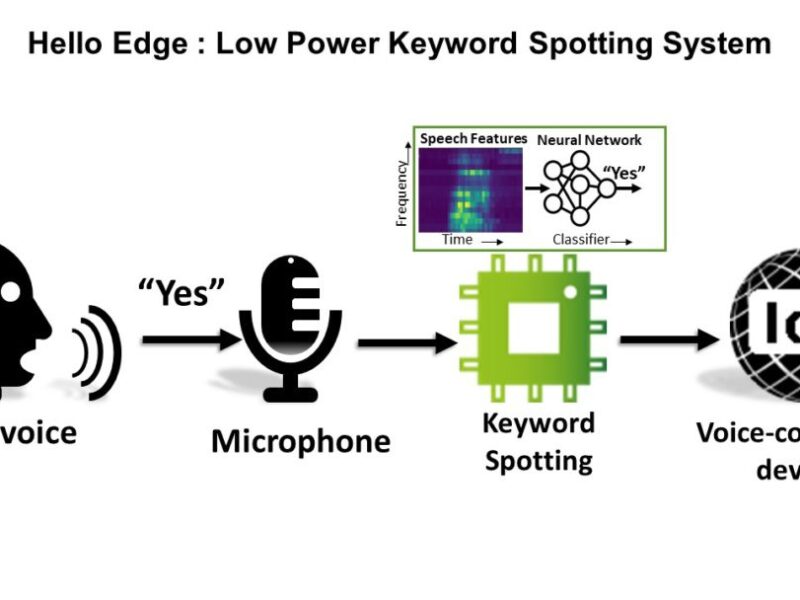
Low power keyword spotting for IoT edge AI
Researchers at CEA-Leti in France have developed a design for always on keyword spotting with a power consumption under 1µW.
The keyword spotting design developed by CEA-Leti uses time-domain signal processing on oscillators locked by injection and is suitable for edge AI devices running on energy harvesters, which supply power below 0.5V.
The design, shown at the ISSCC conference in the US this week, is 0.15mm2 in a 65nm process and uses 998nW of power at 0.4V, under the key threshold for harvesting power from solar or RF sources.
This is the first injection-locked, oscillator-based time-domain audio feature extraction (TD-FEx) design, and it achieves 91 percent accuracy on 10 words. The TD-FEx information is not coded as a voltage but as a time delay of two clocks’ signals. In addition to being well suited for advanced nodes, its advantages are digital-like implementation with low-supply voltage and better noise immunity than current systems.
Some analog-based audio feature extraction (FEx) units using multi-channel Gm-C bandpass filters can supply 10 times the power efficiency of digital FEx units in a comparable silicon area. “However, analog FEx circuits have not demonstrated KWS with more than four keywords,” the paper reports. “They also suffer from a large footprint, challenging technology migration and limited dynamic range at low supply voltage, while speech signals have inherently a high dynamic range.”
“Our system’s silicon area of 0.15mm2 is at least 3.5 times smaller than prior art on the same process node of 65nm,” said Ali Mostafa, lead author of the paper. “With a power of 988nW, our system is nine times more power-and-area efficient than ring-oscillator-based TD-FEx.”
- Leti details move to 10nm, 7nm FD-SOI process in Europe
- Applied Materials, CEA-Leti open joint lab .
Applications beyond speech recognition for this system include predictive maintenance and health monitoring that require on-line frequency decomposition of the sensor data.
 If you enjoyed this article, you will like the following ones: don't miss them by subscribing to :