Microchip adds device qualifications and SoCs to space FPGAs
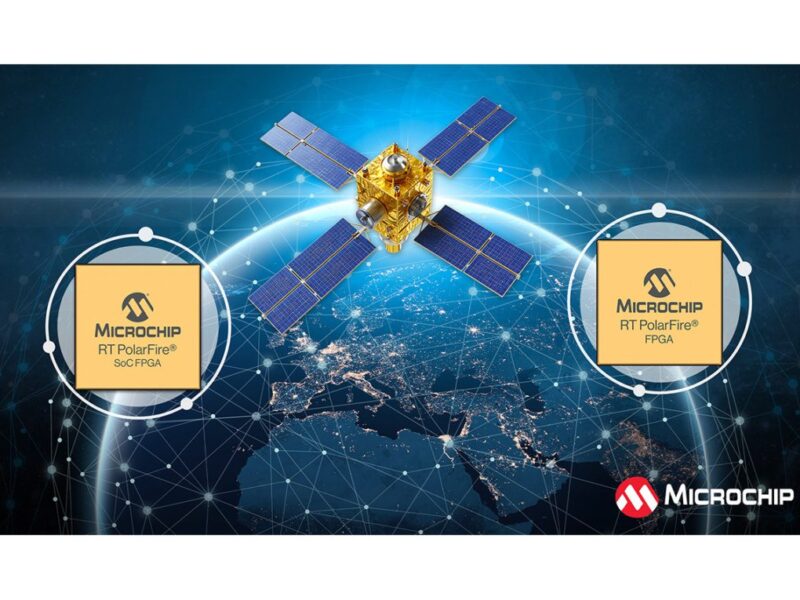
Microchip Technology has announced two new milestones for its Radiation-Tolerant (RT) PolarFire technology, namely MIL-STD-883 Class B and QML Class Q qualification of the RT PolarFire RTPF500ZT FPGA and availability of engineering samples for the RT PolarFire System-on-Chip (SoC) FPGAs.
Unlike traditional SRAM-based FPGAs, RT PolarFire devices utilise nonvolatile technology, making them immune to configuration memory upsets caused by radiation. This immunity eliminates the need for external mitigation measures, helping reduce system complexity and overall cost. RT PolarFire FPGAs consume up to 50% less power than mid-range SRAM-based alternatives, enabling satellite designers to optimise Size, Weight and Power (SWaP) without compromising mission-critical reliability. The PolarFire RTPF500ZT FPGA advances the family’s capabilities, offering enhanced Single Event Latch-up (SEL) radiation performance and increased robustness for inflight programming compared to the original RTPF500T.
“Microchip Technology has a proven track record of supporting critical space missions, spanning low Earth orbit, satellite platforms and deep space exploration,” said Shakeel Peera, vice president of marketing and strategy for Microchip’s FPGA business unit. “Our commitment to stringent quality standards, compliance with international regulations and long-term product reliability has solidified Microchip’s reputation as a trusted provider of aerospace hardware.”
Engineering samples of the RT PolarFire SoC FPGA further strengthen the space-qualified FPGA portfolio. This SoC integrates a real-time, Linux®-capable, RISC-V®-based microprocessor subsystem with a flight-proven FPGA architecture, enabling both flexible software support and deterministic real-time performance. With a roadmap to QML Class V and Class Y, the RT PolarFire SoC FPGA is well suited for central satellite processing, avionics and payload control where high reliability is essential.
RT PolarFire devices are supported by the Libero® SoC Design Suite, a comprehensive IP library, reference designs and solution stacks tailored for space applications. RT PolarFire SoC FPGAs also integrate with Microchip’s Mi-V ecosystem for RISC-V development. Additionally, development kits and hardware platforms are available to facilitate rapid prototyping, hardware validation and system integration, enabling engineers to bring mission-critical space systems from concept to deployment efficiently.
 If you enjoyed this article, you will like the following ones: don't miss them by subscribing to :