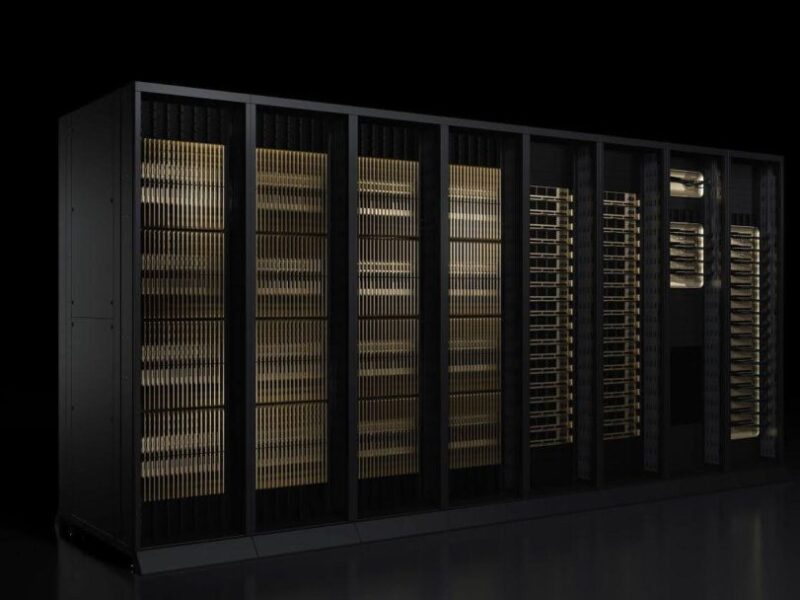
Nvidia consortium pushes 800V power distribution for AI datacentres
Nvidia has announced a consortium of suppliers for 800V high voltage DC power distribution in datacentres. This is a key step to supporting processing racks with 1 MW of power, starting in 2027.
The move to 800V provides an improvement in end-to-end power efficiency of up to 5% while maintenance costs are reduced by up to 70% due to fewer PSU failures and lower labour costs for component upkeep. There are also lower cooling costs as the AC-DC power supplies in the racks are not longer needed.
The silicon providers are Infineon Technologies, MPS, Navitas, Rohm, STMicroelectronics and Texas Instruments with power modules from Delta, Flex Power, Lead Wealth, LiteOn and Megmeet and power systems from Eaton, Schneider Electric and Vertiv.
“We are in healthy and natural competition with a couple of well know competitors, We are proud to be part of the consortium,” said Gerald Deboy, fellow at Infineon Austria.
“Nvidia is not just building faster GPUs, but reengineering the entire power stack to unlock the full potential of AI,” said Mathias Blake, distinguished engineer, core technology at Nvidia.
Today’s 54Vdc racks are hitting power limits of 200kW. The Nvidia GB200 NVL72 and GB300 NVL72 racks have up to eight power shelves to power the compute and switch shelves. Using the same 54 V DC power distribution would mean power shelves would consume up to 64 U of rack space for a megawatt rack, leaving no room for compute. The alternative approach is to use a dedicated rack of power supplies for every compute rack, which takes up valuable space in the datacentre.
By converting 13.8 kV AC grid power directly to 800 V HVDC at the perimeter with industrial-grade rectifiers, most intermediate conversion steps are eliminated. This can minimise energy losses, which typically occur during multiple AC-DC and DC-DC conversions.
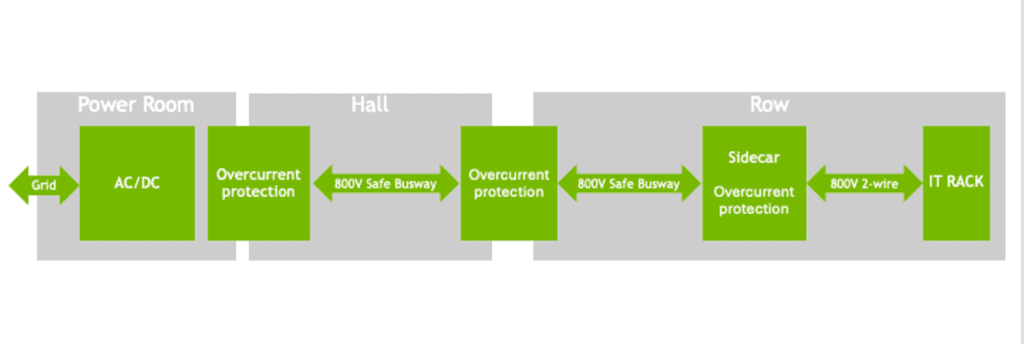
The Nvidia 800V power distribution architecture
This significantly reduces the number of power supply units (PSUs) with fans needed in the power chain. Fewer PSUs and fans leads to higher system reliability, lower heat dissipation, and improved energy efficiency, making HVDC distribution a more effective solution for modern data centers and significantly reducing total component count.
With a single-step AC-DC conversion, the system benefits from a more direct and efficient power flow, reducing electrical complexity and maintenance needs.
Using 800 V busways and switching from 415 V AC to 800 V DC in electrical distribution enables 85% more power to be transmitted through the same conductor size. The higher voltage reduces current demand, lowering resistive losses and making power transfer more efficient so that thinner conductors can handle the same load, reducing copper requirements by 45%.
Using a DC network also eliminates AC-specific inefficiencies, such as skin effect and reactive power losses, further improving efficiency says Blake.
At the racks, the two 800V feeds supply DC-DC converters to drive the GPU devices. Eliminating rack-level AC-DC conversion elements frees up valuable space for more compute resources, allowing for higher-density configurations and improved cooling efficiency.
While higher-voltage DC architectures have been piloted in the past, widespread adoption was limited by technical and deployment challenges. The consortium around Nvidia’s NVLink72 rack designs aims to drive the adoption faster.
“The combination of Infineon’s application and system know-how in powering AI from grid to core, combined with Nvidia’s expertise in accelerated computing, paves the way for a new standard for power architecture in AI data centres to enable faster, more efficient and scalable AI infrastructure,” said Adam White, Division President Power & Sensor Systems at Infineon.
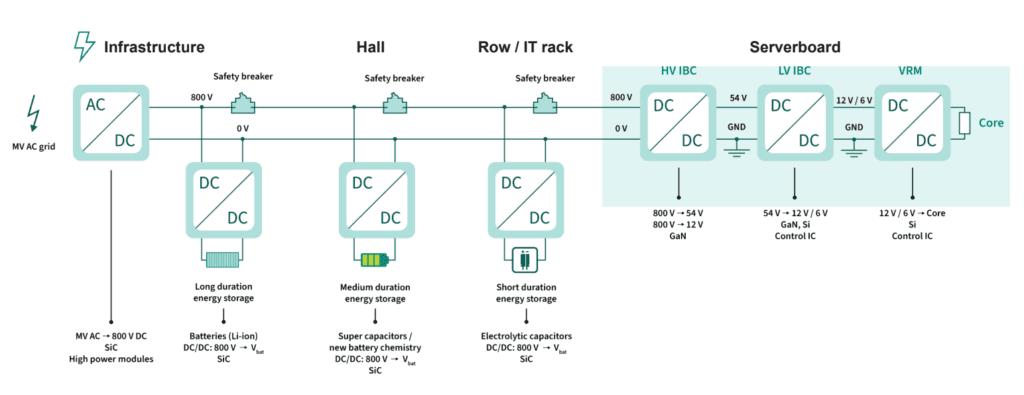
Infineon’s implementation of the 800V architecture
Infineon has developed a 12kW reference design using both gallium nitride (GaN) and silicon carbide (SiC) devices with a benchmark efficiency of ~98%, all while meeting strict hold-up time requirements.
- Navitas targets 80plus Ruby certification
- Energy Star closure hits datacentre power
- 12kW AI battery backup
Meanwhile Navitas is highlighting its AI datacentre power systems in Taipei today with an 8.5kW power supply also powered by GaN and SiC that could meet 98% efficiency, complying with the Open Compute Project (OCP) and Open Rack v3 (ORv3) specifications. Navitas has also developed a patented digital control technique called IntelliWeave that enables peak efficiencies of 99.3% for the power factor correction stage and reduces power losses by 30% compared with existing solutions.
“The exponential growth of AI computing power poses stringent challenges for data center infrastructure. The debut of our latest AI data center PSU achieves dual breakthroughs in efficiency and power density, demonstrating Navitas’ continuous innovation in GaN and SiC technologies and deep understanding of the data centre industry”, said Charles Zha, SVP and General manager of the Asia Pacitic region for Navitas.
“With years of focus on the Asia-Pacific market, we remain committed to aligning cutting-edge technologies with local needs and industry strengths. We look forward to collaborating with industry partners to explore how GaN and SiC innovation can drive efficiency and density upgrades in AI data centers, ensuring computing development progresses along with a sustainable future.”
Moving to 800 V HVDC at the building level introduces new challenges in safety, standards, and workforce training. Nvidia and its partners are actively studying the CapEx and, OpEx, and safety implications of both traditional transformer-based and solid-state transformer (SST) approaches to enable this transition.
However the move to 800V throughout the datacentre also has to include more isolation.
“You need isolation of racks with circuit breakers and to react fast these are a combination of mechanical relays with semiconductor content,” says Deboy at Infineon. “This gives you the change to react fast in microseconds and the mechanical relays are the last result to prevent catastrophic failures.”
www.nvidia.com; www.infineon.com
 If you enjoyed this article, you will like the following ones: don't miss them by subscribing to :