PowerCo brings European battery cell production online at Salzgitter
PowerCo has officially started European battery cell production at its Salzgitter site in Germany, commissioning the first gigafactory dedicated to the Volkswagen Group’s Unified Cell strategy. The move marks a concrete step in localising battery value chains in Europe, with the first cells now entering validation and road testing across several group brands.
For eeNews Europe readers, the development is relevant as it provides insight into how large OEMs are structuring in-house battery manufacturing, and what this could mean for future sourcing, cell formats and production technologies across the European automotive supply chain.
Salzgitter gigafactory moves from build-out to production
The Salzgitter facility is the first PowerCo gigafactory to enter operation and is positioned as the lead plant for subsequent sites planned in Valencia, Spain, and St. Thomas, Canada. According to Volkswagen Group, the factory has begun producing prismatic Unified Cells “made in Europe”, with initial volumes destined for final road tests before series deployment.
The cells are expected to debut next year in the Electric Urban Car Family from Volkswagen, ŠKODA and SEAT/CUPRA. Within the group’s wider battery sourcing strategy, PowerCo is projected to cover around half of Unified Cell demand, with the remainder supplied externally. This hybrid approach could potentially reduce dependency on Asian suppliers while retaining flexibility in chemistry and sourcing.
Unified Cell strategy and technology scope
The Unified Cell concept is designed as a standardised architecture that can accommodate multiple chemistries, including nickel-manganese-cobalt (NMC), lithium iron phosphate (LFP) and, longer term, solid-state variants. The first Salzgitter-produced cell is based on NMC chemistry and is described as delivering around 10 percent higher energy density than previous generation cells used by the group.
Volkswagen states that the cell is optimised for its cell-to-pack battery system, which removes intermediate module stages. From an engineering perspective, this integration could translate into efficiency gains at pack level, although real-world performance will depend on vehicle integration and thermal management strategies.
Scaling, sustainability and digitalisation focus
Production capacity at Salzgitter is planned to ramp to around 20 GWh per year in an initial phase, with expansion potential to 40 GWh depending on demand. PowerCo also highlights sustainability measures at the site, including the use of renewable electricity for energy-intensive processes such as drying rooms, which are typically fossil-fuel powered in conventional cell plants.
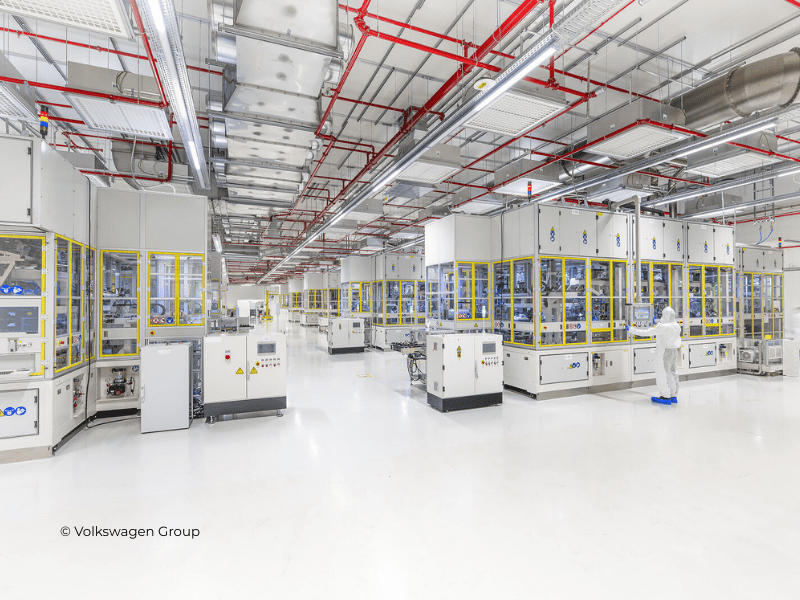
The factory incorporates a high degree of automation and real-time data monitoring. According to the company, thousands of data points from equipment and building systems feed into digital process control and AI-supported quality monitoring, an approach that could influence how future European gigafactories are designed and operated.
 If you enjoyed this article, you will like the following ones: don't miss them by subscribing to :