Three-in-one post quantum cryptography PQC block saves area, power
 Cette publication existe aussi en Français
UK chip designer EnSilica has developed a combined PQC hardware encryption accelerator IP block that cuts the silicon area by two thirds.
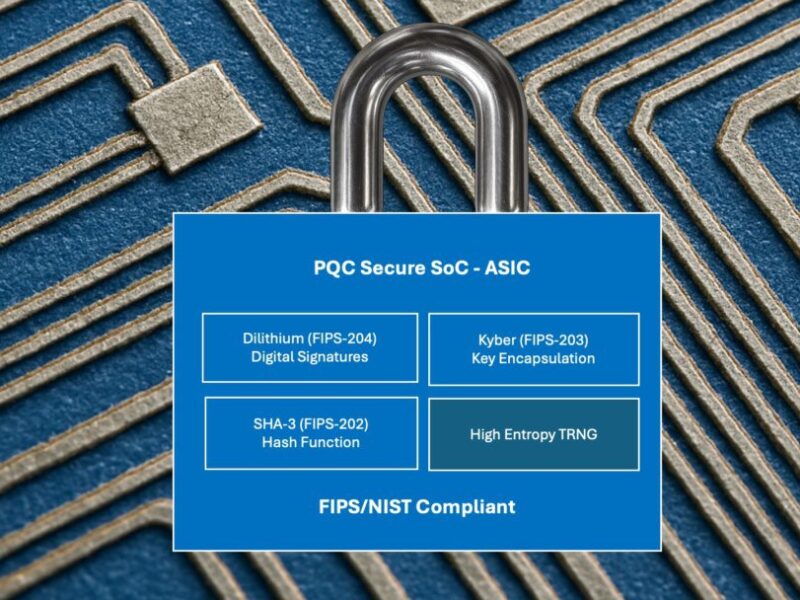
The licensable eSi-CRYSTALS PQC accelerator supports the full CRYSTALS post-quantum cryptography (PQC) suite approved by the US National Institute of Standards and Technology (NIST), Integrating three IP blocks for the Dilithium (FIPS-204), Kyber (FIPS-203) and SHA-3 (FIPS-202) algorithms saves silicon area, power and cost.
After several years of competition, NIST released its first three finalised PQC standards to address the threat of quantum computers cracking the existing AES encryption standards in the future. However the first implementations have been for enterprise and networking systems where the silicon area is less important.
- Ensilica to build fully integrated ASIC for resilient satellite navigation
- IoT ASIC deal with Danish chip designer
EnSilica previously announced separate Dilithium, Kyber and SHA-3 algorithms licensed for use by a major semiconductor company for a 5 nm networking ASIC. The new IP offers a more compact implementation than separate cores. EnSilica also has a full suite of classical cryptographic accelerators including ECC, ECDSA, RSA, AES, ChaCha20, and Poly1305. In addition, the company offers a NIST-compliant true random number generator (TRNG).
Combining the three PQC accelerators into a single block allows PQC algorithms to be used in a wider range of chips, including edge processing.
Harvest now, decrypt later
“The emerging PQC threat is not just theoretical. Security analysts warn that adversaries can already capture encrypted data today, with the intention of decrypting it in the future when quantum capabilities become available, a tactic known as ‘harvest now, decrypt later’,” said Ian Lankshear, CEO of EnSilica. “The implications are profound for those relying on today’s cryptographic schemes, which is why EnSilica’s PQC offering delivers future-proof hardware protection at the silicon level with minimal silicon area for mature and advanced technology nodes.”
Dilithium is used for digital signatures, providing authentication and data integrity, while Kyber is a key encapsulation mechanism that enables secure key exchange. Integrated into the block is also a hardware-optimised implementation of the cryptographic SHA-3 hash function that creates a digital fingerprint of data allowing for robust integrity verification. Together, these algorithms form the foundation for quantum-resistant security in modern systems, ensuring long-term protection of sensitive information.
 If you enjoyed this article, you will like the following ones: don't miss them by subscribing to :