Ultra-thin smart ring for health monitoring
A Swiss startup has developed an ultra-thin smart ring for health monitoring using a tiny LED and sensor.
Senbiosys is a spinout from EPFL in Neuchatel which developed the sensor. It has crowdfunded development of the Iris smart ring.
Many wearable devices today use photoplethysmogram (PPG) sensors placed for example under connected watches with a coloured LED light to measure vital signs like heart rate, blood oxygen levels, breathing rate and blood pressure. After several years of miniaturization research, EPFL engineers have developed technology that concentrates all the monitoring capabilities available on smart watches into an area four times smaller than other devices.
The Senbiosys PPG sensor, developed at EPFL’s Integrated Circuits Laboratory, measures just four cubic millimeters and uses smaller photodetector with an LED that can be less intense.
“Our breakthrough has given rise to around 60 journal articles in the fields of microelectronics and optical sensors,” says Antonino Caizzone, a Senbiosys cofounder who received the 2021 Gilbert Hausmann Award for his thesis in this area. “It’s also led to 11 patents, including some obtained at EPFL, and our work has been cited around 1,000 times.”
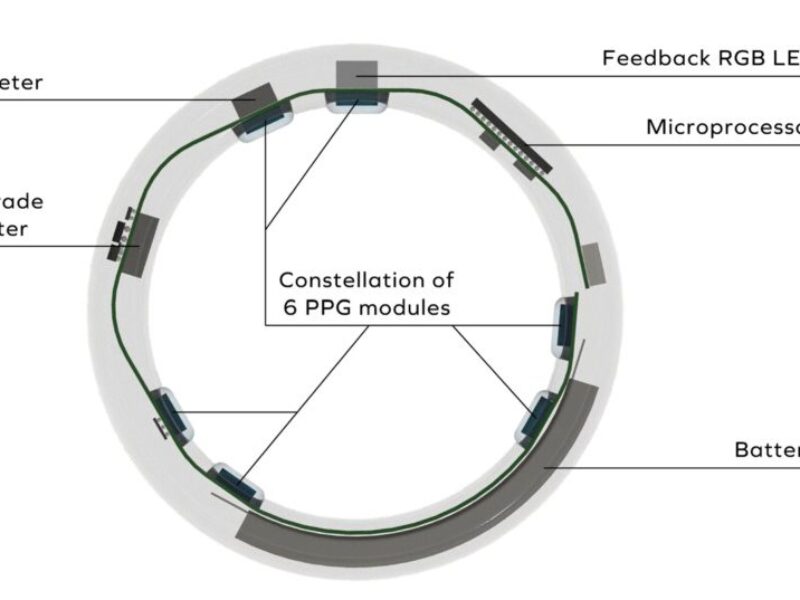
This enables 18 LEDs and six sensors in the smart ring that measures 5 mm wide and 2.5 mm thick with wireless charging in 30 minutes.
- Taking plastic chips into healthcare
- Medical grade ECG/EKG monitoring for consumer designs
- AI smart watches could predict higher risk of heart failure
“We felt there was potential to use our sensors to create a new product directly for consumers,” says Caizzone. “Several journal articles, including one appearing in Frontiers in Physiology in 2019, have shown that taking vital-sign measurements on the wrist isn’t ideal, since data reliability can be impacted by the wrist’s size and shape. Readings taken on the finger or ear are better. Another reason why we decided to develop a smart ring is that watches can sometimes be impractical. They can cause discomfort while sleeping, for example.”
Iris isn’t the first health-monitoring smart ring out there, but what sets it apart is its ultra-compact design and low power requirement: Iris looks more like a piece of jewelry than a health product. The ring can be fully charged in just half an hour. It contains 18 LEDs and six photodetectors, allowing for enhanced accuracy relative to existing products.
“Thanks to inventions we came up with in the lab, we were able to miniaturize the professional-grade sensors used in bulky devices like blood pressure monitors and pulse oximeters,” said Assim Boukhayma, also a Senbiosys cofounder.
Because Iris contains six photodetectors, it collects enough data to calculate averages for each parameter, which isn’t the case for smart watches or more cumbersome smart rings. “Another benefit to Iris’ smaller size is that less materials are needed to make it, meaning we can sell it at a lower price point,” adds Boukhayma.
Senbiosys carried out a clinical study of its technology at the Fribourg cantonal hospital, comparing heart rate data collected by its miniaturized sensors with those collected by an arterial catheter. The study found that the two methods gave comparable readings.
“However, our goal isn’t to create a medical device for doctors but rather to provide a personalized way of tracking different health indicators,” says Boukhayma. “Our eyes are set on prevention. If users see significant changes in their vital signs, that can prompt them to contact their doctor.”
The first version of Iris will provide measurements of heart rate, step count, blood oxygen level, sleep quality, stress level and calories burned. “We intend to continually improve our algorithms and smartphone app and will make updates available online as soon as they’re ready,” he said.
- Guide for medical device development and manufacturing
- Delivering medical cloud AI on smartphones
- First UK Approved Body for medical devices since Brexit
Senbiosys has raised $500,000 in the crowdfunding campaign to move forward with production and fulfill the preorders made by crowdfunding participants, scheduled for delivery in late 2023. “First we’ll determine how many parts we’ll need – mainly the circuit boards, batteries and mechanical components,” says Caizzone. “Then we’ll finalize our assembly process to make sure all the different components are integrated correctly.”
 If you enjoyed this article, you will like the following ones: don't miss them by subscribing to :