Configurable photonic chip with 5THz of optical interconnect
Researchers at Politecnico di Milano in Italy have developed an integrated photonic chip that can handle up free space optical (FSO) signal with 5THz of bandwidth.
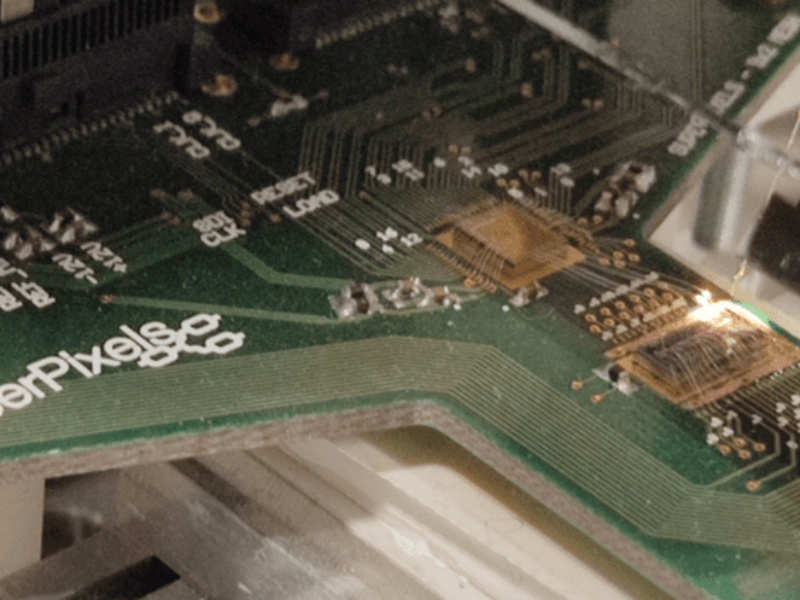
Working with colleagues at the Scuola Superiore Sant’Anna in Pisa, the University of Glasgow and Stanford University as part of the European Horizon2020 Superpixels project, the team found a way to separate and distinguish optical beams even if they are superimposed.
This uses a programmable photonic processor built on a silicon chip of 5 mm2. The processor created is able to receive all the optical beams through a multitude of optical antennas integrated on the chip, to manipulate them through a network of integrated interferometers and to separate them onto distinct optical fibres, eliminating mutual interference. This device allows information quantities of over 5THz to be managed, at least 100 times greater than current high-capacity wireless systems.
- Related articles
- Google replaces fibre connectivity with free-space optics
- First Terabit optical link for chip-to-chip connections
- Scalable CMOS manufacturing of integrated optical devives
- €1.1bn for a European photonics supply chain
Similarly to what happens in optical fibres, even in free space light can travel in the form of beams having different shapes, called modes, and each of these modes can carry a flow of information. Generating, manipulating and receiving more modes therefore means transmitting more information. The problem is that free space is a more variable and unpredictable environment for light than an optical fibre.
“A peculiarity of our photonic processor is that it can self-configure very simply, without the need for complex control techniques. This allows scalability to new versions of the device, capable of handling many beams at the same time, further increasing the transmission capacity. It is also able to adapt in real time to compensate for effects introduced by moving obstacles or atmospheric turbulence, allowing the establishment and maintenance of optimal optical connections”, said Francesco Morichetti, head of the Photonic Devices Lab at the Politecnico di Milano.
“There are many applications in other areas that require advanced processing of optical beams, including high-precision positioning and localization systems for self-driving vehicles, sensors and remote object recognition, portable and wearable devices for augmented reality and new investigation techniques for biomedical applications,” said Andrea Melloni, director of Polifab, the Politecnico di Milano centre for micro and nanotechnologies.
“The ability to manage immense flows of information on miniaturized chips is a peculiarity of integrated photonics. Research in this field is conducted by the Scuola Sant’Anna in synergy with the Inphotec infrastructure and with other Italian research centres, including Polifab. This synergy places Italy in a leadership position on photonic technologies for communication, sensors and biomedical,” said Marc Sorel, professor of Electronics at the TeCIP Institute (Telecommunications, Computer Engineering, and Photonics Institute) of the Scuola Superiore Sant’Anna, who took part in the research.
doi.org/10.1038/s41377-022-00884-8
Related articles
Other articles on eeNews Europe
- TiVo moves into automotive streaming with $109m Norwegian buy
- Newport chip foundry still possible says Nexperia
- €5.5m for 50 qubit photonic quantum computer
- Imperas teams for system level verification for RISC-V
 If you enjoyed this article, you will like the following ones: don't miss them by subscribing to :