Nvidia points to Rubin superchip successor to Blackwell
 Cette publication existe aussi en Français
The CEO of Nvidia has revealed a roadmap for ARM’s Adonis Neoverse processor that will arrive on a one-year rhythm with the replacement for the Grace Hopper superchip
The Rubin platform will succeed the upcoming Blackwell platform, featuring new GPUs, a new ARM-based CPU called Vera, said Jensen Huang, CEO of Nvidia.
The current Grace superchip has 144 ARM Neoverse V2 CPU cores with Scalable Vector Extensions (SVE2), and Nvidia has previously developed its own version of the ARM cores, called Denver and will have been working with the V3 core since 2003 but officially launched in February. As a lead customer for ARM Vera may use the next generation V4 architecture, codenamed Adonis. This is being integrated into a Compute Sub-System (CSS) called Vega.
The V3 architecture has its own CSS and an automotive version, V3AE, which Nvidia could use for its DRIVE autonomous vehicle products.
The cadence of chip launches will also include advanced networking with NVLink 6, CX9 SuperNIC and the X1600 converged InfiniBand/Ethernet switch.
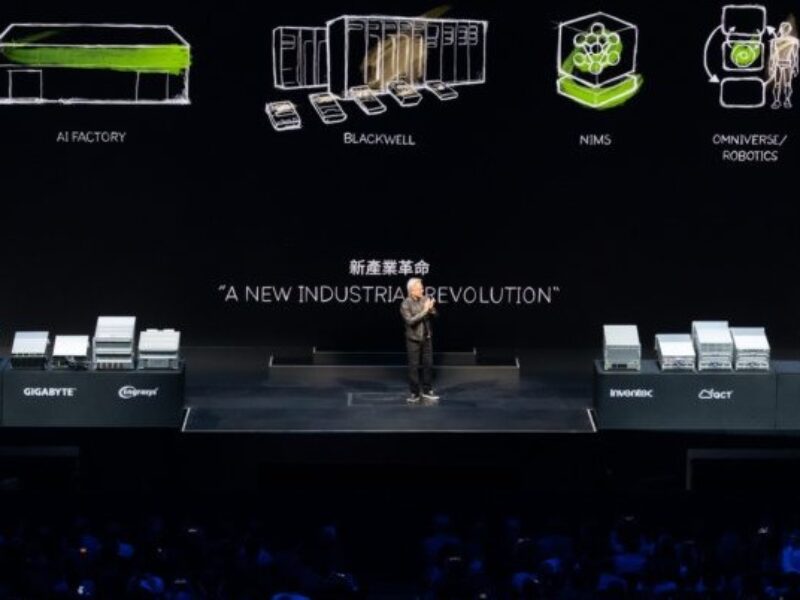
“Today, we’re at the cusp of a major shift in computing,” said Huang at the keynote for the Computex 2024 trade show in Taipei, Taiwan, today. “Our company has a one-year rhythm. Our basic philosophy is very simple: build the entire data centre scale, disaggregate and sell parts on a one-year rhythm, and push everything to technology limits,” said Huang. This will also keep Nvidia ahead of competing technologies such as UALink chip to chip interconnect, proposed by Broadcom, Intel and AMD this week.
Taiwanese manufacturers including Foxconn, Pegatron and Wistron, which make Apple devices including the iPhone, are planning to to use the Blackwell GPU and digital twin technology for their factories.
Chip designer MediaTek is also integrating the Nvidia TAO training and pretrained models into its AI development workflow for IoT device customers. The collaboration brings Metropolis and the latest advances in AI and visual perception to billions of IoT far-edge devices and streamlines software development for MediaTek’s next phase of growth in edge IoT.
Quality control with manual inspections in manufacturing is a multitrillion-dollar challenge. While automated optical inspection systems have been relied upon for some time, legacy AOI systems have high false detection rates, requiring costly secondary manual inspections for verification.
NVIDIA Metropolis for Factories offers a state-of-the-art AI reference workflow for bringing sophisticated and accurate AOI inspection applications to production faster.
Foxconn and its Ingrasys subsidiary use Nvidia Omniverse and Metropolis, along with software from Siemens, to build digital twins for factories, planning efficiency optimizations and worker safety improvement at a number of manufacturing sites. At Computex Foxconn is showing how it uses digital twins to plan placements of many video cameras in factories to optimize its data capture for collecting key insights. It plans to start with the H100 systems and upgrade to Blackwell.
- Foxconn taps Nvidia for AI data centres and EV factories
- Foxconn taps Siemens AI to build digital factories
- Nvidia continues to quadruple sales year-on-year
Pegatron has factories that span more than 20 million square feet and the facilities process and build more than 15 million assemblies per month, while deploying more than 3,500 robots across factory floors. It is using the Nvidia Docker-based AI models called NIM alongside the Metropolis multi-camera tracking reference workflows to help with worker safety and productivity on factory lines. Pegatron’s workflow fuses digital twins in Omniverse and Metropolis real-time AI to better monitor and optimize operations.
TRI, Taiwan’s leading AOI equipment maker, has announced integrating NVIDIA Metropolis for Factories workflow and capabilities into its latest AOI systems and is also planning to use Nvidia NIM to further optimize system performance.
Wistron is also expanding its OneAI platform for visual inspection and AOI with Metropolis. OneAI has been deployed in more than 10 Wistron factories globally, spanning hundreds of inspection points.
 If you enjoyed this article, you will like the following ones: don't miss them by subscribing to :